theyflysohigh : Steve Marsh

email: theyflysohigh@btinternet.com
West Ham United Club Historian : Welcome to the Private memorabilia collection of 'theyflysohigh'

I BELIEVE
Countdown to Christmas
It was the first of December in East London, and winter had laid its claim upon the Boleyn Ground. Frost clung to the iron gates like silver lace, and the breath of passers-by drifted in pale clouds beneath the glow of gas lamps. Inside the old boardroom, where oak panels whispered of long-forgotten meetings, a young apprentice named Steve stumbled upon a cupboard that had not been opened in years.
Within lay a dusty box, its lid worn smooth by time. When Steve lifted it, the hinges creaked like a memory being stirred. Nestled inside was a curious relic: a miniature replica of Syd King’s famous straw hat. The moment his fingers brushed the brim, the air shimmered.
Suddenly, Steve was no longer in the boardroom. He stood pitchside in 1904, the fog rolling in from the Thames as West Ham prepared to face Millwall in a fierce derby. The crowd roared like a storm, boots clattered against the frozen turf, as King barked orders from the touchline, his voice carrying above the din. Before Steve could take it all in, the vision dissolved, and he found himself once more in the quiet boardroom, the box resting before him as if nothing had happened.
But the box held more secrets. Beneath the hat lay a peculiar advent calendar - not the kind filled with chocolate, but one fashioned from old long-forgotten club minute meeting books and wood, its 24 compartments marked with ornate numbers. Each door seemed to hum with anticipation, as though history itself waited to be unwrapped.

Curious, Steve opened the first door. Inside lay a Baines football card, its typography ornate, its hand-drawn figure clad in turn-of-the-century kit. The moment he touched it, the world shifted again. He was whisked away to an Edwardian school playground, where children huddled in caps and scarves, trading cards with wide-eyed excitement. Their chatter was filled with tales of William Grassam’s latest goal, their laughter echoing against the brick walls as the card passed from hand to hand like treasure.
Each day, Steve returned to open another door, and as the days passed he met legends and journeymen, saw triumphs and heartbreaks, and even stood beside Billy Bonds as he collected the Cup in 1975 and Trevor Brooking as he nodded home the winner in 1980. Each door was a portal, each relic a memory, and each moment stitched the fabric of West Ham’s soul.

J. Baines Ltd: The Shield behind the Glory
In the industrial heart of late Victorian Bradford, amid the clatter of looms and the bustle of market stalls, a modest toy shop on North Parade quietly transformed the way football was celebrated and remembered. Its proprietor, John Baines became one of the game’s earliest influencers. Through his invention of the shield-shaped football card, Baines gave young fans a tangible link to their heroes and lay the groundwork for a collecting culture that endures to this day.
Baines’ innovation wasn’t just a novelty; it was a blueprint for the modern football card, printed on distinctive shield and fan-shaped stock and sold in blind packets of six for a halfpenny. They featured stylised illustrations of players and club names that offered a rare visual connection to the teams supported, sparking a collecting craze that spread across Yorkshire and beyond.
Baines’ cards captured the breadth of the footballing landscape, not only the emerging giants of the professional game, but also amateur sides, to long-forgotten village teams like Heckmondwike Casuals, Rotherham Swifts, and Rawdon United. He captured early incarnations of clubs that would later become household names, including Newton Heath (Manchester United) and Newcastle East End (Newcastle United). In doing so, he created a visual archive of football’s adolescence, one that remains invaluable to historians and collectors alike.
Today, the legacy of J. Baines Ltd lives on not just in the hands of collectors, but in the very idea of football as a story told through images, emblems, and ephemera. His shield-shaped cards remain a symbol of early football culture — playful, proud, and steeped in local colour. They evoke a time when the game was still finding its feet, when clubs were community institutions, and when a halfpenny packet could spark a lifelong passion
I BELIEVE
Christmas Countdown : Day 2
Steve’s fingers hovered over the advent calendars second compartment. The tiny brass number “2” gleamed faintly in the boardroom light, as though daring him to open it. With a careful pull, the door swung open to reveal a postcard - its edges tarnished with age, its surface alive with Edwardian ink.
The card was addressed to none other than Syd King, West Ham’s formidable manager, and bore the neat, looping script of Willie Reginald Bray - the man history would remember as The Autograph King.
As Steve touched the card, the room dissolved once more. He found himself in a genteel drawing room, the air thick with pipe smoke and the faint scent of varnished wood. At a writing desk sat Bray himself, spectacles perched on his nose, pen scratching across the postcard with deliberate flourish. The ink glistened, fresh and alive, as though history were being written in real time. Steve leaned closer, hearing Bray’s words as they formed:
"Dear Sir, May I ask you to kindly return this card to above and add your autograph on the other side. Thanking you in anticipation, yrs ffly W.R. Bray. P.S. I sent you a card on Oct 3 last - shall be glad to receive that also."
Thousands of requests flowed from his pen, dispatched to figures great and small. Popes, politicians, sportsmen, and station masters alike received his cards. Some obliged, others refused. William Barnes, depicted on the postcard in the colours of Sheffield United, signed his name in November 1903, adding to Bray’s growing archive. By the time Bray’s quest ended in 1934, he had amassed more than 15,000 autographs - a collection unrivalled in its day.
Not all were willing. George V, Winston Churchill, and Adolf Hitler declined, with Hitler’s office replying politely but firmly that the Führer was already overburdened with work and requesting Bray “refrain from further letters in this regard.”


The scene shimmered, and Steve suddenly understood the scale of Bray’s obsession. Born in Forest Hill in 1879, Reginald Bray had begun his experiments with the postal system in 1898 - sending letters with addresses written in verse, reversed lettering, even arranging to be delivered himself as a “human letter.” But this playful curiosity soon gave way to a deeper passion: the pursuit of autographs by post.
Click this picture Link
to view the postcard and read about the 'Autograph King'
The vision began to fade. The postcard lay in Steve’s hand as he marvelled at the thought: in the club’s 130-year history, so few postcards had ever borne its image - yet here was one of the earliest surviving examples. A treasure that bound West Ham not only to Barnes and Syd King, but also to the eccentric brilliance of Bray himself.
The advent calendar glowed faintly, as if whispering that more secrets lay ahead. Perhaps, Steve mused, Syd King had indeed returned Bray’s second card in 1903. If so, another relic of West Ham’s past might still be waiting to be uncovered - a hidden jewel in the club’s long and storied history.
Steve blinked, and once more and was back in the boardroom, the advent calendar glowing faintly, as though inviting him to open the next door.
I BELIEVE
Christmas Countdown : Day 3
The boardroom swirled again, and Steve felt the floor shift beneath his feet. When the haze cleared, he was standing ankle-deep in mud on Green Street. Around him, a crowd of workmen bustled with purpose - hammering timber, laying bricks, and shouting instructions over the din of carts and barrows. The smell of coal dust mingled with the crisp December air, while children chased battered footballs between piles of rubble. Traders barked their wares, their voices carrying above the clatter of horse-drawn carts.
A foreman, his coat flecked with mortar, raised his voice above the chaos: "This ground will be the pride of East London. A home for the Hammers." Steve realised he was witnessing the birth of the Boleyn Ground - the stadium that would stand as West Ham’s fortress for more than a century, a place where generations would gather to cheer, mourn, and celebrate.

Back in the boardroom, Door 3 of the advent calendar creaked open. Inside laid an Ogden’s ‘Football Colours’ tobacco card, its delicate artwork capturing goalkeeper George Kitchen resplendent in claret and blue. The card shimmered in Steve’s hand, and in an instant he was carried away again. This time, he found himself in a tobacconist’s shop in Liverpool at the turn of the century. The air was thick with the scent of tobacco, the shelves lined with packets of Ogden’s Cigarettes. Beside a polished brass ashtray and a well-thumbed copy of Association Football & the Men Who Made It, the card sat proudly on display - a miniature work of art, hand-painted and glowing with Edwardian colour.

Click this picture Link
to view the Ogden's
tobacco card
Ogden’s Football Colours – West Ham United
In 1905/06, Ogden’s Cigarettes issued one of the most celebrated football card series of the Edwardian era: Football Club Colours. Across 39 football clubs and 12 rugby sides, players were depicted in full kit, each card a jewel of artistry that transformed everyday cigarette packets into collectible treasures.
Card No. 47 proudly features West Ham United’s goalkeeper George Kitchen. Joining the Hammers from Everton in August 1905, Kitchen stood an imposing 6ft 1in - a giant of his time, perfectly built for the position. He quickly became a stalwart in Syd King’s side, his presence between the posts reassuring and formidable.
Yet Kitchen was more than a shot-stopper. Remarkably, he scored five goals for West Ham - all from the penalty spot. On his debut against Swindon Town, he converted from twelve yards, becoming the first West Ham goalkeeper ever to score on debut. His name was etched into the club’s Edwardian folklore, a reminder that even those guarding the goal could seize moments of glory. For collectors, the card is more than a portrait. It captures the artistry of Ogden’s, the spirit of Edwardian football, and the early years of a goalkeeper whose legacy helped shape West Ham’s story.
The vision drifted away, like smoke curling into the rafters of history, and Steve found himself once more in the boardroom, the advent calendar glowing faintly. Three doors opened, three treasures revealed - and yet twenty-one more waited, each promising another journey into the heart of West Ham’s past.
I BELIEVE
Christmas Countdown : Day 4
The advent calendar shimmered again as Steve opened Door 4. Inside laid a football comic card from the 1920s, its bold black and white image jumped to the fore, its figure exaggerated. The moment he touched it, the boardroom dissolved into a storybook world.
Players with hammer-shaped heads thundered across the page, their boots comically oversized, speech bubbles bursting with cries of “Up the Irons!” A ball the size of a cannon rolled across the pitch, chased by caricatured Hammers who seemed half-cartoon, half-legend. Steve laughed aloud - it was football reimagined as fantasy, a world where West Ham’s heroes were immortalised in ink and exaggeration.
The comic book closed, and Steve found himself back in the boardroom, the advent calendar glowing faintly, as though inviting him to open the next door. Four doors opened, four stories told - each one a lasting memory of West Ham’s past.

Click this picture Link
to view the Sport and Adventure card
D.C. Thomson & Co Ltd – Signed Real Photos
The 1921/22 season marked the dawn of the free comic give-away. Until then, most football memorabilia had been the preserve of tobacco companies, but publishing giants D.C. Thomson & Co Ltd - later famed for The Dandy and The Beano - began to capture the imagination of young readers. Their first boys’ paper, Adventure, launched in 1921, and its success spawned a string of titles: The Rover and The Wizard in 1922, The Vanguard in 1924, The Skipper in 1930, and The Hotspur in 1933.
In February 1922, West Ham’s leading centre-forward, Syd Puddefoot, became the subject of the club’s first comic give-away hero. A unique series of signed real photos depicted him proudly in claret and blue. Yet fate intervened almost immediately. Within days of the card’s release, Puddefoot was transferred to Falkirk for a world-record £5,000 fee. The boys’ paper scrambled to adapt, issuing a Scottish edition that still showed him in Hammers’ attire - a curious relic of a hero caught between two worlds.
Before his record-breaking move north, Syd Puddefoot had already carved his name deep into West Ham’s history. Born in Limehouse in 1894, he was a true East Ender, and his rise from local football to the professional game embodied the spirit of the community. Joining West Ham in 1912, he quickly established himself as a prolific scorer, his powerful shot and commanding presence making him one of the most feared forwards of his era.
During the First World War, Puddefoot served his country but returned to the Hammers with undiminished talent. By the early 1920s, he was the club’s talisman, leading the line with distinction and helping to secure promotion to the First Division in 1923 - the same year West Ham reached the inaugural FA Cup Final at Wembley. His goals were not just numbers; they were moments of pride for East London, celebrated in pubs, playgrounds, and factory floors alike.
For the supporters who watched him at Upton Park, Puddefoot was more than a footballer - he was a symbol of local strength and ambition. His departure to Falkirk may have been a shock, but his legacy in East London remained indelible, a reminder of the days when a boy from Limehouse could rise to become the Hammers’ first great star.
I BELIEVE
Christmas Countdown : Day 5
The chatter of a playground filled Steve’s ears as the calendar shimmered and glowed once more. He saw schoolchildren spilling through the iron gates at home time, caps askew and satchels swinging, their pennies already spent on the latest adventure comics. Some clutched fresh copies of Sport and Adventure or Champion, the ink still sharp on the covers. Others huddled beneath the railings, swapping issues eagerly, their laughter and excitement echoing across the yard - a chorus of youthful energy that mirrored the growing craze for stories in print.

Steve smiled at the scene. These papers were more than entertainment; they were windows into a world of heroes, sporting triumphs, and daring escapades, and tucked within their pages lay treasures that young readers cherished - cut-out cards of footballers, modest in design but rich in nostalgia.
The playground faded, and Steve found himself back in the boardroom, the faint glow of the advent calendar beckoning him onward. Five doors opened, five stories told - each one a fragment of West Ham’s past, stitched together like pages in a boy’s adventure paper.

Sport and Adventure – Our Gallery of Famous Footballers
Sport and Adventure was one of the many British boys’ story papers that flourished in the golden age of juvenile publishing. Launched in 1918 by Amalgamated Press, it ran until 1923, offering weekly doses of athletic drama and adventure. Its stories celebrated physical prowess, moral courage, and patriotic duty, often set in schools, clubs, or far-flung colonial landscapes. Text-heavy and sparsely illustrated, it followed the tradition of “story papers” rather than comic strips, but its impact was no less powerful.
Football, already a national obsession by the early 1920s, featured prominently. In 1922, the paper issued a card series titled 'Our Gallery of Famous Footballers'. These cut-outs, trimmed from weekly issues, were eagerly collected by boys across Britain. Surviving examples today are often worn, unevenly cut, or incomplete - fragile relics of youthful hands and playground trades. Among the players immortalised was West Ham’s outside-left, William Thirlaway.
Born in Washington, County Durham in 1896, Thirlaway began his football journey at Usworth Colliery before joining West Ham in 1921. A speedy and skilful winger, he made 36 appearances and scored twice in the 1921/22 season. His pace stretched defences, his crosses supplied forwards like Syd Puddefoot and Vic Watson, and his tireless work ethic earned him admiration from the terraces.
Though not a prolific scorer himself, Thirlaway’s contribution was vital to the Hammers’ attacking play during a formative period in the club’s history. He lost his place during the promotion push of 1922/23 and departed before West Ham’s Wembley debut, but his impact lingered. For supporters of the time, he was a symbol of the club’s growing ambition - a player whose speed and spirit helped shape West Ham’s early rise to prominence.
I BELIEVE
Christmas Countdown : Day 6
The sixth door opened, and Steve felt the roar of a crowd swell around him. Wembley rose from the haze - vast, proud, and still unfinished. Built in just 300 days, the stadium was a marvel of ambition: its twin towers standing sentinel over terraces that stretched endlessly, though the paint was barely dry and the concrete still raw. It was meant to hold 125,000, yet on this day over 200,000 surged through its gates, drawn by the promise of history.
The fans arrived in waves - men in flat caps, women in Sunday best, children clutching rattles and flags. Trains and trams had carried them from every corner of the country, and soon the sheer weight of humanity spilled onto the pitch itself. Restless, eager, they pressed forward until mounted police advanced to restore order. Among them Billie the White Horse nudged the throng gently back, her pale figure etched forever into football folklore.
Through the mist of history, Steve saw the claret and blue stride out for their first FA Cup Final. The date was 28 April 1923, and West Ham United faced Bolton Wanderers in the inaugural Wembley showpiece. The noise was deafening, the occasion monumental. Bolton struck early, David Jack scoring within two minutes, and though West Ham fought bravely, the Wanderers’ superiority told. Jack Smith added a second, sealing a 2–0 victory. Yet the match was almost secondary - the spectacle itself was unforgettable. Wembley had announced itself as football’s cathedral, and the Cup Final as the nation’s grandest ritual.

Back in the boardroom, the day’s compartment revealed a curious treasure: a Colman’s Mustard vesta case. Small, silver-plated, and practical, it gleamed with blue and gold enamel, its inscription proudly declaring:
“ENGLISH CUP FINAL / BOLTON WANDERERS 2 / WEST HAM UNITED 0 / WEMBLEY PARK 1923.”
For the supporter who carried it, striking a match became more than a habit - it was a ritual bound to football’s greatest stage, a flicker of flame tied to Wembley’s opening chapter, now remembered less for smoke than the spark of history it carried.

Click this picture Link
to view 1923 Memorabilia
Colman’s Mustard Vesta Case
Among the curiosities of football memorabilia, few items capture the romance of the 1923 FA Cup Final quite like this. Colman’s, already a household name, understood the power of promotion. By producing a keepsake tied to the nation’s game, they ensured their brand lived not only on the dinner table but in the pockets of fans.
The vesta case fused national pride with everyday life, its enamel shining as a reminder of Bolton’s victory and West Ham’s brave debut. Today, surviving examples are scarce, treasured not only as advertising novelties but as tangible relics of Wembley’s first great occasion - a mustard-tinted memory of football history.
The roar of the crowd faded, and Steve found himself once more in the quiet boardroom. Six doors opened, six stories told. The advent calendar glowed faintly, whispering that more treasures awaited - each one a step deeper into the Hammers’ past.
I BELIEVE
Christmas Countdown : Day 7
The seventh door shimmered once more, and Steve heard the rustle of paper packets and the excited chatter of children outside a corner shop. He saw boys in short trousers and caps, clutching their pennies as they queued for “sweet cigarettes” - the harmless confectionery sticks that carried with them a hidden treasure.
As the shopkeeper handed over the packets, eager fingers tore them open, not just for the sugary treat but for the card inside. Footballers, cricketers, and teams stared back in vivid print, each one a hero to be swapped, collected, and cherished. The air was thick with the smell of boiled sweets and peppermint, and Steve realised he was witnessing the rise of one of Britain’s great traditions: confectionery cards.

The vision slipped into the past, carried on the chants of the crowd, and Steve found himself once more back in the boardroom, beside the advent calendars faint glow. Seven doors opened, seven treasures revealed - each one a fragment of football’s past, stitched together like cards in a collector’s album

Click this picture Link
to be transported to the 1925 memorabilia page
Barratt & Co – Confectionery Cards
Established in 1848, Barrett & Co, opened their Wood Green sweet factory in 1880. By the mid-20th century, they were the largest sugar confectionery manufacturer in the UK, their name synonymous with childhood treats. Long before their takeover by Geo. Bassett & Co Ltd in 1966, Barratt had carved out a place in sporting history.
In 1925, they issued their first sports card series - Cricketers, Footballers and Football Teams - a set of 260 cards given free with sweet cigarettes. Within a few years, Barratt was producing a veritable “who’s who” of British football, immortalising the stars of the interwar years. These cards, modest in size but rich in nostalgia, became prized possessions, tucked into satchels and swapped in playgrounds across the country. Today, surviving examples are highly sought after, treasured as both sporting relics and childhood memories. Among those featured was West Ham’s greatest goalscorer: Vic Watson.
Victor Martin Watson, born in Girton, Cambridgeshire in 1897, joined West Ham United in 1920. Over the next 15 years he became the club’s most prolific striker, scoring an extraordinary 326 goals in 505 appearances - a record that still stands as West Ham’s all-time highest tally. Tall, commanding, and ruthlessly clinical, Watson was the spearhead of Syd King’s side throughout the 1920s and 1930s. He led the line with authority, his goals driving West Ham through their formative First Division campaigns and securing his place among the finest centre-forwards of his era. His partnerships with inside-forwards - first with fellow great Syd Puddefoot, and later with Jimmy Ruffell - gave the Hammers a cutting edge that thrilled the East End faithful and etched Watson’s name into football folklore.
The centre-forwards consistency was remarkable, scoring 20 or more goals in seven different seasons, including a career-best 50 goals in 1929/30. His feats earned him recognition beyond the Boleyn Ground, with five caps for England between 1923 and 1930, in which he scored four times.
For the young collector who pulled his Barratt card from a packet of sweet cigarettes, Watson was more than just a picture. He was a symbol of West Ham’s ambition, a hero whose goals echoed across the terraces and whose name became synonymous with claret-and-blue glory.
I BELIEVE
Christmas Countdown : Day 8
The eighth door creaked open, and Steve was engulfed by the hum of wartime London. The boardroom dissolved into streets lined with sandbags and blackout curtains, where wardens barked instructions and the drone of aircraft training flights carried faintly across the sky. Even in these uncertain days, football carried on. Players balanced duty with the game, fans clutched ration books as tightly as their tickets, and still the chorus of “I’m Forever Blowing Bubbles” rose defiantly into the summer air.
Suddenly, Steve found himself at Wembley in June 1940. The terraces were dotted with khaki uniforms and factory workers, their faces weary but determined. This was no ordinary fixture – it was the Football League War Cup Final, a competition hastily arranged to keep the game alive during the shadow of war, months before the Blitz would descend on the capital.


Click this picture Link
to be transported to the 1930-1940 Trophy Cabinet
The 1940 War Cup Final
West Ham United v. Blackburn Rovers
The game itself was tense and hard-fought. Blackburn, with their reputation as seasoned campaigners, pressed forward with determination, their forwards testing the Hammers’ defence with long balls and sharp runs. West Ham, under the steady guidance of manager Charlie Paynter, relied on grit and organisation. The back line, marshalled by the uncompromising Herman Conway in goal, stood firm against the Rovers’ attacks.
The breakthrough came after 35 minutes, a quick exchange down the flank saw George Foreman whip in a cross, and Sam Small - alert and decisive - pounced. His shot flew past Blackburn’s goalkeeper, sending the East End faithful into raptures. The roar echoed around Wembley, a sound of triumph that seemed to defy the sirens and the shadows of war. From then on, West Ham held their ground with dogged determination. Blackburn pressed for an equaliser, but the Hammers’ defence refused to yield. Every clearance, every tackle, was cheered as though it were a victory in itself. When the final whistle blew, the 1–0 scoreline was more than a result - it was a statement of endurance.
The programme for the final was a modest wartime production, its paper thin and its design simple, yet it carried immense significance. Inside were line-ups, notes, and reminders of the extraordinary circumstances under which the game was played. Surviving copies today are rare, treasured as symbols of football’s defiance in the face of war.
The tickets, too, were plain but powerful. For the supporter who clutched one in 1940, it was more than entry to a match - it was a passport to hope, a chance to forget the sirens and the rationing, if only for ninety minutes.
West Ham’s victory in the War Cup Final remains one of the club’s proudest moments. It was not just about silverware, but about resilience. The players, many of whom would soon serve in the forces, gave their supporters a memory to cling to as Britain braced itself for the trials ahead. For East London, already feeling the strain of rationing and uncertainty, the triumph was a reminder that even in unsettled times, football’s magic endured.
The vision ebbed into silence, leaving the boardroom hushed with remembrance and the faint glow of the advent calendar casting shadows across the walls. Eight doors opened, eight stories told - and now the war years had left their mark upon the countdown, reminding him that football’s spirit is never extinguished, even when the world itself seems to tremble.
I BELIEVE
Christmas Countdown : Day 9
The ninth door opened with the scent of warm bread and sugared buns. Steve found himself transported to a bustling Glasgow street in the early 1950s, where the shop fronts of City Bakeries Ltd glowed invitingly under the winter lamps. Inside, tea-rooms hummed with chatter, waitresses carried trays of scones and pots of steaming tea, and children pressed their noses to glass counters piled high with pastries.
But it wasn’t just the cakes that drew them in. With every purchase came a paper shield - brightly coloured, bearing the name of a football club. Boys and girls clutched them eagerly, slipping them into satchels or flicking them against playground walls in the craze that would later be known as “Flicksy.”

Steve watched as a group of children huddled outside, their laughter echoing as they flicked their shield cards against the bricks, each bounce deciding who would win the pile. The West Ham shield, claret and blue, was prized above all - a fragile paper relic that carried the pride of East London all the way from Glasgow.

City Bakeries – Football Club Shields
City Bakeries began its journey in the early 20th century in Glasgow and grew into one of Britain’s largest chains of bakeries and tea-rooms. By the 1930s, with more than sixty branches, they rivalled even Lyons in scale. Beyond bread and cakes, the company fostered community spirit, running recreation grounds with bowling greens, tennis courts, and even theatre outings.
Between the late 1940s and mid-1950s, City Bakeries issued a remarkable series of 300 Football Club Shields, tucked free into their pastry delights. These shield-shaped cards became playground currency, sparking fierce games of skill and chance. Though many surviving examples today are worn, creased, or trimmed, West Ham versions remain highly sought after - commanding prices of £50 or more, a testament to their rarity and nostalgic charm.
The idea of a bakery chain fostering sport and community was not so far removed from Arnold Hills’ vision for West Ham’s federated clubs half a century earlier. Hills’ Memorial Grounds had hosted cycling and motorcycle races, drawing crowds of over 16,000, blending recreation with spectacle. In their own way, City Bakeries mirrored that spirit - offering not just bread, but belonging, and weaving football into everyday life.
The vision and smell began to fade, and Steve was back in the boardroom, the ninth door closed behind him. Nine treasures revealed, nine journeys taken - from iron gates to paper shields, each one a reminder that football’s story is not only written in goals and glory, but in the everyday rituals of fans, families, and communities.
I BELIEVE
Christmas Countdown : Day 10
The tenth door opened with the rustle of newsprint. Steve found himself in a bustling 1950s newsroom, the air thick with tobacco smoke and the clatter of typewriters. Ink-stained printers fed great sheets through rollers, while cartoonists hunched over drawing boards, their pens scratching out bold lines and exaggerated features.
On the desk before him lay a slim booklet - a set of 48 caricature drawings illustrated by Mickey Durling, issued in 1950 by The Sunday Empire. The pages brimmed with humour and artistry, footballers rendered with oversized boots, mischievous grins, and exaggerated swagger. Among them, two familiar figures stood out in claret and blue: Dick Walker and Eric Parsons.


Click this picture Link
to be transported back to the 1949-50 memorabilia page
The Sunday Empire - A Sporting Chronicle
Founded in Manchester in 1884 as The Umpire, the paper was the first successful provincial Sunday newspaper in England. Subtitled “A Sporting, Athletic, Theatrical and General Newspaper”, it catered to the passions of its readers - sport, theatre, and spectacle. Over the decades, its name shifted like the headlines it carried: Sunday Empire News in 1944, Empire News and the Umpire in 1950, back to Empire News in 1953, and finally merged with the Sunday Chronicle in 1955.
By 1960, under Roy Thomson’s ownership, it was absorbed into the News of the World. Yet in 1950, the paper captured football’s spirit in caricature form, immortalising players in a way that was playful, collectible, and instantly memorable.
One-club man, Dick Walker embodied loyalty and resilience. Joining West Ham in 1934, he served the Hammers for two decades, captaining the side through the war years and beyond. A commanding centre-half, he was known for his uncompromising tackling and steady leadership. By the time Mickey Durling’s pen captured him in caricature, Walker was already a symbol of continuity - a player who had carried West Ham through turbulent times and remained a pillar of the club.
Eric Parsons, nicknamed “The Rabbit” for his speed, joined the West Ham ground-staff in 1938. A lively winger, he thrilled supporters with his pace and direct running, stretching defences and delivering crosses with precision. His caricature in the booklet captured that energy - boots flying, hair swept back, a grin that suggested mischief as much as determination. Though his time at Upton Park was relatively brief, Parsons left his mark as part of the post-war generation that brought flair back to the claret and blue.
For the supporter who tucked the booklet into their pockets, these caricatures were more than cartoons. They were snapshots of heroes, drawn with affection and humour, bridging the world of journalism and football collectables. Today, surviving copies in un-cut condition are scarce, but they remain a charming relic of an era when newspapers were not just read, but collected, cherished, and laughed over in playgrounds and pubs alike.
The vision bowed out gracefully, like a player leaving the pitch to cheers, and Steve was back in the boardroom. Ten doors opened, ten treasures revealed - each one a fragment of football’s past, stitched together like caricatures in a booklet, their lines bold and their stories enduring.
I BELIEVE
Christmas Countdown : Day 11
The eleventh door opened with the sugary scent of childhood. Steve stepped into a corner shop in 1958, shelves gleaming with jars of boiled sweets, liquorice twists, and bright boxes of Chix Confectionery. Children jostled at the counter, coins clinking as they bought bubble gum – not only for the chew, but for the prize inside: a football card.
From one packet slipped West Ham’s John Bond, his likeness bold and colourful; from another, the elusive and ever so rare Bond variation, a miniature treasure. The shop seemed to shimmer, and suddenly Steve was at the Boleyn Ground, watching “Muffin” stride across the turf, boots thudding, presence commanding.

Chix Confectionery had mastered the art of pairing sugar with sport. In the 1950s, their football card series carried on the tradition of tobacco cards, but with children as the eager audience. By 1958, the third set of Footballers was sweeping playgrounds, boys swapping and flicking cards, their heroes immortalised in print.
Though simple in design, the cards held lasting charm: full-figure portraits of stars from English and Scottish clubs, offered at a time when football was booming in post-war Britain. For countless young fans, these pocket‑sized images were their first tangible link to the idols they cheered on Saturday afternoons.

Click this picture Link
to be transported back to the 1958-59 memorabilia page
John Bond, born in Dedham, Essex in 1932, joined West Ham United in 1950 from Colchester Casuals. Over the next 16 years, he became one of the Hammers’ most dependable right backs, making 444 appearances in all competitions and scoring 37 goals.
Strong, composed, and adventurous from the flank, Bond was a key figure in West Ham’s rise during the 1950s. He played almost every match in the 1957/58 Second Division championship season, helping secure promotion back to the top flight. His consistency carried into the 1960s, where he was part of the side that won West Ham’s first FA Cup in 1964 and then the European Cup Winners’ Cup in 1965.
Though not as flamboyant as some contemporaries, Bond’s reliability and ability to score from defence made him a fan favourite. His Chix card captured him at the height of his powers – a versatile defender whose contributions carried West Ham into a new era.
For the child who pulled John Bond’s card from a packet, it was more than a collectible. It was a piece of magic – a link between the sugar rush of the sweet shop and the roar of the Boleyn Ground, a reminder that football lived not only on the pitch but in the everyday rituals of fans.
The sugary smell faded, and Steve was back in the boardroom. Eleven doors opened, eleven treasures revealed – each one a step deeper into the Hammers’ past, stitched together like cards in a collector’s album, their edges worn but their stories eternal.
I BELIEVE
Christmas Countdown : Day 12
The twelfth door burst open to a roar of celebration. Steve found himself swept into the terraces of the Boleyn Ground in the spring of 1958, the crowd surging with joy as Ted Fenton’s side secured promotion to the First Division. The claret and blue faithful sang “Bubbles” with renewed pride, their voices echoing across East London. At the heart of it all was Vic Keeble, whose goals had fired the Hammers into the top flight, each strike greeted with thunderous applause and the promise of a brighter future.

Back in the boardroom, the advent calendar revealed a glittering collection – plastic star badges, moulded in claret, their surfaces catching the light with a simple charm and shaped like stars, Steve recognised them instantly: the coveted star badges of the 1950s and 1960s, treasured by fans and now preserved in the National Football Collection. These badges, though commonly called “star badges,” were prized possessions for young supporters, pinned proudly to lapels, scarves, or school satchels. Today, the National Football Collection holds around 800 examples, and continues to seek out more to preserve this colourful slice of football culture. Among them are West Ham versions in rich claret, each one a miniature emblem of pride. For the fans who wore them, they were more than decoration - they were a badge of belonging, a symbol of loyalty to the Hammers.

The Players behind the Badges
Malcolm Musgrove – A skilful winger who joined West Ham in 1953, Musgrove’s pace and creativity lit up the flanks. He played a vital role in the promotion-winning side and later became a respected coach. His badge captured the flair and energy that defined the Hammers’ attacking play in the late 1950s.
Ken Brown – A steadfast centre-half whose calm authority anchored the defence. Joining the club in 1953, Brown’s consistency and courage made him a cornerstone of the promotion side, trusted by teammates and adored by supporters. His badge shone with the resilience and reliability that steadied the Hammers’ rise to the First Division.
Mike Grice – A versatile winger signed in 1952, Grice’s tireless running and sharp crossing added balance to the attack. Though less heralded than some, his contribution was vital in knitting together Fenton’s team. His badge carried the quiet strength of a player whose graft and guile helped secure West Ham’s new chapter.
Together, these players symbolised the dawn of a new era. Their names, etched into plastic badges and programmes, carried the pride of East London into the wider football world. For the supporter who pinned a claret star badge to their jacket in 1958, it was more than a trinket - it was a declaration of faith, a promise that West Ham had arrived among the elite.
The cheers faded, and Steve found himself back in the boardroom. Twelve doors opened, twelve treasures revealed - each one a spark of history, glowing like stars catching the light of memory.
I BELIEVE
Christmas Countdown : Day 13
The thirteenth door opened with the sound of a whistle and the shuffle of boots on gravel. Steve found himself at the edge of the Chadwell Heath training pitch in 1961, where a new figure was shaping the future of West Ham United. Calm, thoughtful, and meticulous, Ron Greenwood had arrived as manager, bringing with him a philosophy that would transform the club.
Gone were the days of rigid drills and barked orders. Greenwood believed in intelligence, technique, and teamwork. He encouraged his players to think, to pass, to move – to play football as an art as well as a contest. Under his guidance, the Boleyn Ground became a place where flair and discipline coexisted, and where young talents could flourish.
It was here that the foundations of West Ham’s famed Academy of Football flourished. Greenwood’s methods nurtured not only established stars but also the next generation, instilling a culture where youth development was central to the club’s identity. And in 1963, that promise was tested against Liverpool in the FA Youth Cup final – a clash that would announce the Academy’s arrival.
The tie was played over two legs, and the young Hammers faced a formidable opponent in Liverpool’s youth side. At Anfield, under the glare of floodlights and the roar of the Kop, West Ham held their nerve, showcasing the passing patterns and composure Greenwood had instilled, but fell to a 3-1 defeat.
Back at Upton Park, it looked all over as Liverpool had stretched their aggregate lead to 5-2 at half-time, but the 13,200 in attendance were treated to a spectacular comeback as the Hammers rallied to score four unanswered goals in the second half to take the FA Youth Cup! The star of the show was Martin Britt, who scored four of the goals, all of them headers.


The terraces brimmed with pride as the youngsters paraded the trophy with the same joy as any senior triumph. Dawkins was presented with the match ball, which he still cherishes today. For supporters, the Youth Cup win was more than silverware. It was proof that Greenwood’s philosophy was bearing fruit, that the Academy could produce players of intelligence and artistry to rival any in the land. The Liverpool match became a touchstone, remembered not just for the goals and the celebrations, but for the sense of destiny it carried. These boys were the future – and some would soon step into the first team, carrying Greenwood’s vision onto the grandest stages.
Greenwood’s arrival marked the beginning of a golden era. He nurtured players who would become icons – Bobby Moore, Geoff Hurst, Martin Peters – and instilled a belief that West Ham could compete not just with grit, but with grace. His emphasis on ball control and tactical awareness was revolutionary, setting the Hammers apart in a game still dominated by brute force.
By the early 1960s, West Ham were no longer outsiders. They were contenders, their football admired across the country. Greenwood’s vision was building towards something historic: the club’s first major trophy.
As Steve watched, the scene shimmered into Wembley once more – but this time not the chaos of 1923. Instead, it was the spring of 1964, and West Ham were preparing for the FA Cup Final against Preston North End. The terraces buzzed with anticipation, claret and blue scarves waving proudly. Greenwood’s philosophy had carried the Hammers to the grand stage, and the players he had nurtured were ready to etch their names into history.
Though the door had not yet revealed the trophy itself, Steve could feel the promise of it – the sense that West Ham’s story was about to change forever.
The vision closed like a curtain, applause fading into recollection, and Steve found himself back in the boardroom. Thirteen doors opened, thirteen treasures revealed – each one a step closer to glory, glowing like the promise of Wembley beneath Greenwood’s guiding hand.
I BELIEVE
Christmas Countdown : Day 14
The fourteenth door swung open to a thunderous cheer. Steve found himself swept into Wembley Stadium on 2 May 1964, the air alive with claret and blue scarves, rattles clattering, and voices raised in song. This was the day West Ham United claimed their first major trophy – the FA Cup.
The terraces buzzed with anticipation as Ron Greenwood’s side strode out to face Preston North End. The match programme, clutched tightly by supporters, carried the line‑ups, Greenwood’s calm words of encouragement. Tickets, simple in design yet priceless in meaning, were tucked into jacket pockets, each one a passport to history.
The game itself was a rollercoaster of nerves and exhilaration. Preston drew first blood, only for John Sissons to haul West Ham level. The Lacashire side restored their advantage, but Geoff Hurst - rising high in the box – levelled again with a header that rattled the net. Then, in the dying moments, Ronnie Boyce delivered the decisive strike, sealing a 3–2 victory and sending the claret and blue faithful into delirium. Bobby Moore, calm and commanding, lifted the Cup with quiet dignity, while the players danced across the turf, their joy unrestrained.


It was more than a win. It was the culmination of Greenwood’s vision, proof that West Ham could marry artistry with resilience. For the players – Moore, Hurst, Boyce, and their teammates – it was the beginning of a golden era, one that would carry them to European glory and World Cup immortality.
Beyond the pitch, the advent calendar revealed a treasure trove of keepsakes: rosettes in claret and blue, their ribbons frayed but proud; souvenir pennants emblazoned with “Wembley 1964”; and commemorative mugs, chipped yet cherished, each one a relic of triumph. For the fans who carried them home, these tokens were more than souvenirs – they were proof that West Ham had arrived, that the club’s spirit could be bottled in porcelain and cloth. In the days after the final, fans clipped headlines from newspapers, pasting them into scrapbooks that chronicled the triumph.
Memorabilia of the Day
Match Programme – A modest publication, priced at a few pence, yet a cherished relic. Its pages carried the names of heroes, team notes, and adverts that now read like time capsules, each one a portal back to Wembley ‘64.
Ticket Stub – A simple slip of paper, but for the fan who held it, it was a key to glory. Surviving stubs are treasured keepsakes, often creased but tangible links to the roar of 100,000 voices.
As Steve stood among the jubilant crowd, he felt the weight of history. The FA Cup gleamed in Bobby Moore’s hands, lifted high above the Wembley turf. The roar of the fans, the confetti, the sheer emotion - it was all bound together in that moment, a triumph that would echo through generations.
The vision vanished into a roar, swallowed by the voices of the faithful, and Steve was back in the boardroom. Fourteen doors opened, fourteen treasures revealed - each one a spark of history, shining like the Cup itself beneath the Wembley sun.
I BELIEVE
Christmas Countdown : Day 15
The fifteenth door opened to the sound of foreign voices and the flutter of flags. Steve found himself at Wembley once more, but this time the banners were not just claret and blue - they were draped in the colours of the German flag. It was 19 May 1965, and West Ham United were about to write their name into continental history.
The road to Wembley had been long and varied. Greenwood’s men had first swept aside La Gantoise of Belgium, their passing game too sharp for the visitors. Sparta Prague came next, a stern test in the quarter‑finals, where Moore’s calm defending and a Standen penalty save carried the Hammers through. A 31,780 crowd were treated to a thrilling second-leg tie against the Swiss side Lausanne Sports in an 'all-out attack from first to last', produced seven goals and was only ultimately settled by Brian Dear's 89th-minute strike and a 6-4 aggregate score line. In the semi-final, Real Zaragoza of Spain brought flair and fire, but West Ham’s resilience and Greenwood’s tactical nous saw them triumph, setting the stage for the grand finale.


Click this picture Link
to be transported back to the 1964-65 season
Now, under the Wembley floodlights, the crowd buzzed with anticipation as Ron Greenwood’s side strode out to face TSV 1860 Munich in the European Cup Winners’ Cup Final. The match programme, carried the line-ups and the promise of a new frontier for English football. Tickets, tucked into wallets and purses, were more than entry slips - they were passports to a night when East London pride met European ambition.
The game was tense, played with skill and determination. Munich pressed hard, but West Ham’s defence, marshalled by Bobby Moore, held firm. Then came the breakthrough: Alan Sealey, the winger with a burst of pace, struck twice in quick succession. His goals sent Wembley into raptures, sealing a 2–0 victory and delivering West Ham’s first European trophy.
It was a triumph that resonated far beyond East London. Greenwood’s philosophy of intelligent, passing football had conquered Europe, and the Hammers had become ambassadors of the English game.
For the fans who sang “Bubbles” under the Wembley lights, the victory was more than silverware. It was proof that West Ham could dream beyond domestic borders that the claret and blue could shine on the grandest stage. Greenwood’s side had not only won a trophy - they had won respect, admiration, and a place in football’s wider story.
The vision turned another page, the story continuing in memory’s book, and Steve found himself back in the boardroom. Fifteen doors opened, fifteen treasures revealed - each one a spark of history, glowing like floodlights on a European night.
I BELIEVE
Christmas Countdown : Day 16
The sixteenth door opened with the sound of trumpets and the roar of a nation. Steve found himself swept into Wembley once more, but this time the stage was the 1966 World Cup Final. Flags fluttered, songs echoed, and the hopes of England rested on the shoulders of three men in claret and blue.
Bobby Moore – Calm, elegant, and commanding, captained England with the same poise he showed at Upton Park. His reading of the game was unmatched, and when he lifted the Jules Rimet Trophy, he became not just West Ham’s greatest son, but a national icon.
Geoff Hurst – The striker who etched his name into history with a hat-trick in the final against West Germany. Martin Peters – Intelligent, versatile, and ahead of his time, Peters scored England’s second goal in the final. Together, these three embodied the club’s contribution to the nation’s greatest footballing triumph. For West Ham supporters, the victory was doubly sweet - the world champions were not just England’s, but theirs.

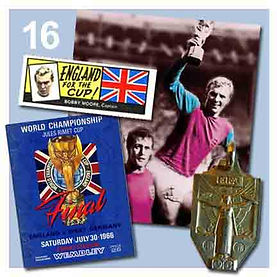

Click the picture Link
to be transported back to 1966 World Cup memorabilia
1966 was the pinnacle of English football, but surprisingly few cards were produced for the tournament which makes these 'World Cup Footballer Stickers', also known as World Cup stamps amongst the rarest sought after item from the period. The A&BC stickers can cause confusion as they look like stamps with their perforated edges, and sometimes listed and sold as stamps rather than stickers.
For the price of 1d. you received a piece of bubble gum, plus one sticker with 50 in the series to collect, 35 player portraits in vertical format including world stars Uwe Seeler (West Germany), Pele (Brazil), Gianni Rivera (Italy) and Bobby Moore who was also depicted as one of the 15 horizontal stickers showing both player and national flag, though most collectors today would be happy to own just one or two from this series.
Their rarity is due to the fact that they were destined to be stuck down, mine ended up on my bedroom door with my football posters, and those that do turn up are commonly found stuck to school books and scrapbooks. Do you have one of these relics from your childhood, a stuck down version would put a smile on your face at £15, and an unwrapped stamp would widen your grin at a whopping £50.
As Steve stood among the jubilant crowd, he felt the weight of history. Moore, Hurst, and Peters had carried West Ham’s spirit onto the world stage, proving that the claret and blue could shine brightest of all. The roar of Wembley, the confetti, the sheer emotion - it was all bound together in that moment, a triumph that would echo forever.
The vision settled into history, etched among the treasures of the past, and Steve found himself back in the boardroom. Sixteen doors opened, sixteen treasures revealed - each one a spark of history, glowing like the Jules Rimet Trophy beneath the Wembley sun.
I BELIEVE
Christmas Countdown : Day 17
The seventeenth door opened with the crackle of a newspaper stand. Steve found himself on a London street in 1968, the smell of ink and paper drifting from the kiosks and boys clutching copies of the London Evening News, their excitement not for the headlines but for the black-and-white football cards tucked inside.
That season, the paper issued ‘Stars in Action’ a series of 18 black-and-white postcards. Distributed free with the newspaper they captured players in dynamic poses and were instantly collectible. Among them was a young Trevor Brooking, his image captured at the dawn of a career that would soon make him a West Ham legend.
But Brooking’s likeness wasn’t confined to the Evening News. In East London, the Newham Recorder also issued player portraits, celebrating local heroes and giving supporters a tangible connection to their idols. Brooking’s portrait appeared there too – a reminder that his rise was not only a story for the terraces but one proudly chronicled in the community’s own newspaper.

For the supporters who pulled the Brooking cards from the folded pages, they were more than just giveaways. They offered a glimpse of the future – a rising star whose elegance and vision would carry West Ham into the 1970s and beyond. Graceful on the ball, intelligent in his movement, and already admired for his composure, he embodied Ron Greenwood’s philosophy of football played with thought and artistry.
Though still at the start of his journey, Brooking’s inclusion marked him out as one to watch. For fans, it was a thrill to see his face among the established names, a sign that the Hammers’ next great chapter was already being written. And indeed, that chapter unfolded magnificently.

Click this picture Link
to be transported back to 1968-69 memorabilia
Over the next seventeen years, Brooking became the club’s beating heart, amassing 643 appearances and 102 goals. He was five times voted Hammer of the Year, his consistency and elegance unmatched and his influence stretched beyond Upton Park. Brooking earned 47 caps for England, representing his country at the 1982 World Cup, though injury limited his role. Still, his reputation as a player of intelligence and grace was secure, admired far beyond East London. Even after hanging up his boots in 1984, he remained loyal to West Ham, returning briefly as caretaker manager in 2003 and later serving the wider game as Director of Football Development at the FA, championing youth and grassroots football.
Today, both cards remain treasured relics of a time when newspapers carried not just stories, but heroes. For West Ham supporters, his cards are a reminder of the moment when a young midfielder first stepped into the spotlight. And as the calendar’s pages turned, Brooking’s journey felt like the perfect gift: a career unwrapped slowly across the years, each season another ribbon untied, until the whole of West Ham could marvel at the treasure within.
The vision slipped into legend, its glow eternal in claret and blue, and Steve found himself back in the boardroom. Seventeen doors opened, seventeen treasures revealed – each one a spark of history, glowing like newspaper portraits tucked into scrapbooks of memory.
I BELIEVE
Christmas Countdown : Day 18
The eighteenth door opened to a sea of claret and blue as Wembley Stadium beckoned once more. On 3 May 1975, Steve was swept into the roar of the crowd as West Ham United faced Fulham in the FA Cup Final. The terraces rattled with song, scarves waved proudly, and the air was thick with anticipation.
Fulham, led by Alan Mullery and former West Ham favourite Bobby Moore, but the Hammers had their own heroes ready to shine. The match itself was tight in the first half, nerves and tension hanging over the stadium as both sides probed for openings. But in the second half, the breakthrough came. Alan Taylor, a striker plucked from Rochdale only months earlier, struck twice in quick succession. His goals – sharp, instinctive finishes – sealed a 2–0 victory and delivered West Ham their second FA Cup triumph.

It was a day of symbolism as much as success. Bobby Moore, the club’s greatest icon, now wore Fulham’s white, yet his presence only heightened the poignancy of West Ham’s victory. Billy Bonds, the new captain, lifted the Cup high, embodying the passing of the torch from one generation to the next. Trevor Brooking, elegant in midfield, orchestrated play with his usual composure, while youngsters like Taylor proved that fresh blood could carry the Hammers forward. For supporters, it was more than a win – it was a statement that West Ham’s tradition of artistry and resilience would endure.
Steve was then transported to a living room of the mid-1970s, the radiogram humming softly as a record spun. But this was no pop album – no Beatles or Bowie. Instead, the grooves carried the roar of Wembley, the commentary of the 1975 FA Cup Final between the London sides.

By the swinging sixties, the idea of devoting an LP to Cup Final match commentaries had become a popular novelty. Fans could relive the drama long after the final whistle, listening to the voices of commentators and the roar of the crowd as if they were back in the stadium. These albums became cherished keepsakes, blending football with the era’s love of recorded sound.
Produced by Quality Recordings Ltd, the 1975 release captured the all-London final in vivid detail. Instead of a pop star gracing the cover, the sleeve featured West Ham’s heroes themselves: Alan Taylor, the two-goal striker whose finishing sealed victory, and Bobby Gould, proudly parading the Cup around Wembley.
For supporters, it was a perfect marriage of sound and sight – the voices of the match pressed into vinyl, and the image of triumph emblazoned on the cover. To place the needle on the record was to relive the day: Taylor’s goals, the roar of the crowd, and the moment the Cup was lifted high in claret and blue hands.
Today, surviving copies of the LP are treasured memorabilia. Their cardboard sleeves may be worn, their vinyl scratched, but they remain powerful relics of a time when football glory was immortalised not just in print or photograph, but in sound. For the fan who owned one, it was more than a record – it was Wembley in the living room, a chorus of memory played at 33 rpm.
The crackle of a needle on vinyl faded, and Steve found himself back in the boardroom. Eighteen doors opened, eighteen treasures revealed – each one a spark of history, spinning like voices on vinyl across the years, and this one echoing with the memory of Wembley, where claret and blue banners unfurled and a new chapter of West Ham’s story was written.
I BELIEVE
Christmas Countdown : Day 19
The nineteenth door opened to a single, unforgettable moment: Trevor Brooking stooping low, guiding the ball into the net with his head. The simplicity of the goal made it eternal, a memory carved into Wembley’s heart.
There was also a rustle of sweet wrappers and the laughter of children trading cards in playground corners. Steve was carried back to the late 1970s, when Geo. Bassett & Co Ltd – famed for their confectionery – unveiled a fresh series of football collectibles.
Inside packets of their popular candy sticks lay hidden delights: Football Candy Stick cards, each bearing the portrait of a player from across the English game. Printed in bold colours and simple designs, they were irresistible to young fans – a sugary treat for the mouth, and a treasured keepsake for the scrapbook.

Bassett’s entry into the football card market was part of a longer tradition. Earlier in the century, Barrett & Co. had pioneered the idea of pairing sweets with sport. Their “Barrett Footballers” cards of the 1930s and 1950s were among the first to bring the heroes of the pitch into the hands of children, tucked inside packets of chewing gum and confectionery. These sets often featured head and shoulder portraits or full-length figures, printed in vivid colours that stood out against the drabness of post-war Britain. For many young fans, Barrett cards were the gateway to collecting – swapped in playgrounds, traded for marbles, and pasted into homemade albums.
By the 1960s and 70s, Barrett’s legacy had been absorbed into Bassett’s wider empire, ensuring that the tradition continued. Bassett, already a giant of the sweet world, understood the magic of linking sweets with football.

Their candy stick cards carried forward Barrett’s pioneering spirit, becoming part of childhood ritual – flicked against walls, tucked into pockets, and treasured long after the sweets were gone. Today, surviving examples from both Barrett and Bassett are cherished as nostalgic relics, reminders of simpler joys and the enduring bond between football and the sweet shop.
Alongside these cards, the period also saw the introduction of Sigma Sports Silhouettes Action Portraits – striking block-coloured depictions of famous footballers caught in motion. These silhouettes captured the dynamism of the game, transforming players into iconic shapes that fans could collect, display, and admire.
And then there were the FKS “Soccer Stars” sticker albums, another playground obsession of the 1970s. Issued annually, these albums invited children to collect and paste glossy stickers of their footballing heroes into neatly printed team pages. Unlike the random thrill of candy stick cards, FKS albums offered structure – the satisfaction of filling every slot, completing every team, and seeing the season’s story unfold in miniature. For many, the hunt for missing stickers became a ritual as intense as the matches themselves, with swaps and trades echoing the camaraderie of the terraces.
And of course, there was Waddingtons’ Top Trumps British Strikers. A deck of cards that turned footballers into statistics and strategy, it invited children to pit their heroes against one another in battles of goals scored, caps won, and appearances made. Unlike the chance of a sweet packet or the orderliness of a sticker album, Top Trumps offered competition – a game within the game, where knowledge and luck combined in playground duels.
For the children of the 1970s, these were more than collectibles – they were passports into football’s wider world, tokens of belonging, and sparks of imagination carried from the sweet shop to the school playground.
And then, as the nineteenth door closed, Steve found himself back in the boardroom. The laughter of playground trades faded into the quiet hum of memory, replaced by the steady rhythm of pen on paper, the shuffle of notes, the careful crafting of history. Here, the boardroom became its own kind of playground – a place where past and present could be shuffled like cards, dealt into stories, and laid out in sequences that revealed the game’s enduring magic.
Nineteen doors opened, nineteen treasures revealed. Each one a spark of history, glowing like Top Trumps, Bassett candy sticks, and FKS stickers tucked safely into the pockets of memory – now gathered, ordered, and retold in the boardroom, where nostalgia becomes narrative and football’s legacy is played out once more.
I BELIEVE
Christmas Countdown : Day 20
The twentieth compartment opened with the shuffle of cards and the peel of stickers. Steve found himself back in 1986, when West Ham’s finest season was not only etched in memory but captured in the collectibles of the time. West Ham United, under John Lyall, produced one of the most remarkable seasons in the club’s history.
The Hammers finished third in the First Division, their highest-ever league placing. For months they had been genuine title contenders, pushing Liverpool and Everton all the way. Upton Park was alive with belief, every match charged with the energy of a team playing beyond expectation.

Yet the campaign was not without its cruel twists. The winter of 1985/86 was harsh, with biting cold and heavy snow leaving pitches unplayable. Postponements piled up, and what might have been a steady march toward glory became a stop-start affair. By spring, the backlog of fixtures forced West Ham into a relentless run of games, often three or four in a week. Fatigue crept in, momentum faltered, and the dream of the title began to slip away. Many supporters still believe that the weather, more than any rival, interrupted the rhythm of Lyall’s men and hindered their run-in at the season’s end.
The side became immortalised as The Boys of ’86, a squad whose spirit, skill, and togetherness captured the imagination of supporters.
Though the title eluded them, the Boys of ’86 remain etched in claret and blue folklore.

Their achievement was not just about league position, but about belief, unity, and the joy they brought to Upton Park. For fans, it was proof that West Ham could stand tall among the giants, playing football with courage and flair.
Among the memorabilia produced that year was a distinctive set of 16 cards issued by the Health Education Council, designed to promote the message of healthy living through football. Each card featured a player from England’s “No Smoking” team, their portraits used to inspire young fans to kick the habit before it began.
West Ham’s own England international Alvin Martin was among those chosen, his image printed as part of the campaign. For supporters, it was a proud moment – their centre-half not only a hero on the pitch, but a role model off it, lending his name to a cause that reached playgrounds and classrooms across the country.
No season of the 1980s was complete without the ritual of the Panini sticker album, and 1986 was no exception. Football 86 carried the familiar grid of team pages, waiting to be filled with glossy portraits of players in their club colours.
For West Ham fans, the thrill of peeling back a sticker to reveal Tony Cottee, Frank McAvennie, Phil Parkes or Tony Gale was part of the magic of that campaign. Albums were swapped in playgrounds, duplicates traded with friends, and the hunt for the elusive “shinnies” became as much a part of fandom as the roar of Upton Park itself.
Together, the No Smoking cards and Panini stickers captured the spirit of 1986 in paper and glue. They were more than collectibles – they were cultural snapshots, reminders of a season when West Ham stood tall and their players became icons both on and off the pitch.
The vision dissolved into song, bubbles rising as the boardroom fell quiet. Twenty doors opened, twenty treasures revealed - each one a spark of history, glowing like sticker albums and campaign cards clutched into the hands of young fans.
I BELIEVE
Christmas Countdown : Day 21
The twenty-first door shimmered with artistry. Steve was transported to Upton Park, the spring sun casting long shadows across the pitch. The ball arced high, and there was Paolo Di Canio - hanging in the air, suspended in a moment of pure theatre. His right boot sliced cleanly through the ball, sending it crashing into the net against Wimbledon.
The crowd gasped as if witnessing a masterpiece, their voices rising in awe. It was not just a goal, but a performance - a fusion of instinct, technique, and imagination that seemed to defy gravity. For those who saw it, the volley became more than a strike; it was a symbol of Di Canio’s mercurial genius, a reminder that football could be art.
For West Ham supporters, Di Canio’s volley was more than three points. It was a gift, a moment of artistry that elevated the ordinary into the extraordinary. His passion, his unpredictability, his flair - all crystallised in that single strike.
When FILA became West Ham’s kit supplier, they produced a distinctive 3D lenticular player card set. These cards used lenticular printing so that when tilted, the image shifted from the player in a formal suit to the same player in the club’s FILA kit. They were part of a promotional release tied to the new sponsorship and are now considered highly collectable pieces of late‑90s memorabilia.

As the millennium approached, another treasure quietly entered the world of West Ham collectibles. Futera released their Millennium 2000 Fans Selection card set – a glossy, chrome‑trimmed celebration of the players chosen by supporters themselves. These cards felt different: part trading card, part time capsule, each one capturing the mood of a club striding into a new era.
There was young Joe Cole, all promise and electricity, his card practically humming with the sense that something special was taking shape. Supporters saw in him the street‑footballer’s imagination, the boy who played as if the ball were stitched to his boots.
Alongside him stood Trevor Sinclair, immortalised mid‑stride, the card echoing the athletic grace that made him such a force down the flank. His overhead kick for QPR may have been the stuff of national highlight reels, but in claret and blue he became a symbol of tireless commitment and quiet class.

Then came the reassuring presence of Steve Lomas – sleeves rolled up, jaw set, the heartbeat of the midfield. His card didn’t need flourish; it radiated the graft and grit that supporters recognised instantly. A captain in spirit who wore the armband with pride.
Rio Ferdinand appeared too, captured in that brief moment before he became one of Europe’s most coveted defenders. The Futera card showed him as West Ham fans remember him best: elegant on the ball, impossibly composed for his age, a defender who seemed to glide rather than run. A reminder of the Academy’s ability to shape not just good players, but great ones.
Stuart Pearce’s inclusion brought a different energy altogether. His card felt carved from granite - jaw clenched, eyes blazing with that unmistakable competitive fire. Even in the twilight of his career, Pearce radiated authority. He wasn’t just a left‑back; he was a standard‑bearer, a warrior whose presence alone lifted those around him.
And of course, Paolo Di Canio appeared again, this time not suspended in mid‑air but captured in Futera’s metallic sheen, an action portrait of charisma and controlled chaos. Even on cardboard, he seemed ready to burst into life.
And overseeing it all was Harry Redknapp, the manager’s card offering a knowing smile beneath the Futera sheen. He was the architect of this blend of youth and experience, the man who nurtured Cole and Ferdinand while coaxing every last drop of wisdom from veterans like Pearce. His inclusion gave the set a sense of narrative - a reminder that eras are shaped not only by players, but by the hands that guide them.
The Millennium 2000 set became more than a collection. It was a snapshot of a squad that blended youth, artistry, and hard‑earned experience – a reminder of a moment when hope felt tangible and the future shimmered with possibility.
The vision faded, and Steve found himself back in the boardroom. Twenty-one doors opened, twenty-one treasures revealed - each one a spark of history, glowing like Di Canio’s volley suspended forever in the theatre of memory.
I BELIEVE
Christmas Countdown : Day 22
The twenty‑second door opened with a softer glow, as though the memory behind it carried both pride and pain. Steve felt the air shift, the boardroom dissolving into a warm May afternoon in Cardiff. The colours were vivid - claret, blue, and the bright red of Liverpool - but beneath them ran a current of something deeper. Hope. Nerves. Destiny.
West Ham only a season removed from the Championship, but you wouldn’t have known it from the way they played. They moved with courage, with belief, with the kind of freedom that comes when nobody expects you to write the script. And for long, glorious stretches of that 2006 FA Cup Final, it felt as though the impossible was within reach.
There was Jamie Carragher’s own goal, Ashton’s poacher’s finish; Konchesky’s looping cross‑shot that seemed to hang in the air for an eternity before dropping into the far corner. The claret‑and‑blue end erupted, a roar that felt like it could lift the roof clean off the Millennium Stadium.

But football can be cruel. Steven Gerrard’s thunderbolt - struck from a distance that seemed almost unreasonable - tore through the moment like a shard of fate. Extra time came and went. Penalties followed. Hearts broke.
Yet even in defeat, something precious remained. That day became part of West Ham’s story not because of the heartbreak, but because of the bravery. A side barely a year out of the Championship standing toe‑to‑toe with one of Europe’s giants, refusing to bow, reminding the world - and themselves - of who they were.
The door shimmered again, and the scene shifted. Now it was 2012, the club marching toward Wembley once more. The stakes were different, but the feeling was the same: a season’s worth of toil condensed into ninety minutes, the promise of a return to the Premier League hanging in the balance.

Blackpool were the opponents, dangerous and unpredictable, a side who played with a kind of joyful chaos that could unpick anyone on their day. And from the first whistle, they showed it. Tom Ince drifted into pockets of space, Stephen Dobbie threaded passes through impossible gaps, and Matt Phillips kept stretching the pitch until it felt like the whole game might spill over the touchlines. West Ham had to weather storms - real ones - moments where Blackpool carved out chances that made claret‑and‑blue hearts lurch.
But West Ham carried something else: a sense of purpose that felt forged from the lessons of years past. Carlton Cole battled tirelessly, his strength and determination leading the line, holding off defenders, dragging the team up the pitch when they needed breath. When he spun and finished to open the scoring, it felt like a release - a reminder that this team could impose itself when it mattered.
Blackpool hit back, of course. They always did. Ince’s equaliser was a dagger and a warning, and for a spell the Tangerines played with a fluency that made the West Ham end tighten with nerves. Rob Green had to stand tall. Winston Reid and James Tomkins threw themselves into blocks that felt like acts of defiance as much as defence. And then came the moment, the one that rewrites a season.
As the game edged toward its final act, Cole muscled through again, forcing a loose ball into the danger zone. It fell to Ricardo Vaz Tê - the man who had arrived mid-season and transformed the club’s fortunes - and he reacted with the instinct of someone who understood destiny when it rolled toward him. He smashed the ball into the net. Wembley erupted. The claret‑and‑blue army sang as one, banners waving like sails in a jubilant sea. The final whistle confirmed it: West Ham were back in the Premier League.
From heartbreak to redemption, from Cardiff to Wembley, from the sting of 2006 to the triumph of 2012 - the club had walked through fire and found its way back.
The twenty‑second door closed gently, leaving Steve with the echo of those journeys: the agony, the resilience, the refusal to fade. Another treasure revealed, another memory glowing in the long corridor of West Ham’s story.
I BELIEVE
Christmas Countdown : Day 23
The twenty‑third door opened with a hush, as though even the calendar understood the reverence of what lay behind it. Steve felt the familiar pull of memory, but this time it was different - heavier, richer, threaded with the bittersweet glow of endings and beginnings. The boardroom dissolved, and he found himself standing once more on Green Street, the old floodlights rising above him like sentinels guarding a century of dreams.
It was the Farewell to the Boleyn Ground season - a campaign unlike any other in West Ham United’s long, unpredictable story. Every match felt like a page being turned, every goal a line written in the final chapter of a beloved book. The air around Upton Park seemed charged, as if the ground itself knew its days were numbered and was determined to burn brighter than ever before.

Slaven Bilić, returning as manager, brought with him not just tactical nous but a sense of belonging. He understood the club’s heartbeat because he had once been part of it. Under his guidance, the team played with a swagger that felt both modern and nostalgic - a blend of grit and guile that echoed the great sides of the past while forging something new.
Dimitri Payet became the season’s talisman, a player whose feet seemed dipped in magic. Free kicks bent like brushstrokes, passes threaded through impossible gaps, moments of brilliance arriving with such regularity that supporters found themselves laughing in disbelief. Around him, Mark Noble led with the quiet authority of a man who had lived every inch of the club’s journey.
Michail Antonio, Aaron Cresswell, Cheikhou Kouyaté, Manuel Lanzini - each contributed to a season that shimmered with possibility.

But beneath the excitement ran a constant undertow of emotion. Every home match carried the weight of history. Supporters lingered longer, sang louder, looked around more often. They memorised the angles of the stands, the creak of the old stairwells, the way the floodlights painted the pitch in familiar patterns. They knew they were saying goodbye, one match at a time.
Originally, fate had arranged for Swansea City to be the final visitors to the Boleyn Ground. A respectable opponent, a tidy narrative, a gentle closing chapter. But football has a way of rewriting its own scripts. As West Ham progressed in the FA Cup, and Manchester United did the same, fixture lists shifted, dates moved, and suddenly the calendar took on a new shape. The final match at the Boleyn Ground on 10 May 2016 would not be against Swansea. It would be against Manchester United.
A quirk of fate, yes – but one that carried a strangely poetic weight. United had long been both adversary and measuring stick, the club against whom West Ham so often defined themselves. They were the giants famously felled in 1992, Kenny Brown’s winner derailing their title charge even as relegation still swallowed the Hammers whole. And in the FA Cup, it always seemed to be them again: another trek to Old Trafford, another away tie against the Red Devils, drawn so often that many Hammers fans joked darkly it felt like a fix. United became the recurring character in West Ham’s cup tale, the familiar shadow on the horizon. To face them in the final match at the Boleyn Ground felt like destiny tightening its grip.
As the season wound toward its conclusion, the anticipation grew. Supporters spoke of the final game in hushed tones, as though discussing a sacred ritual. Tickets became relics. Scarves, shirts, and programmes were collected with the care of archivists preserving the last fragments of a civilisation.......... And then came the night itself.
The twenty‑third door widened, and Steve felt the roar of the crowd wash over him - a sound that seemed to rise from the very foundations of the old ground. The streets outside were a sea of claret and blue, thousands gathering hours before kick‑off, singing, chanting, embracing. The air crackled with emotion: pride, nostalgia, defiance, love.
Inside, the stadium pulsed with energy. Flags waved. Chants rolled from stand to stand. The players emerged to a wall of noise that felt almost physical, a final salute from a fanbase determined to send their home into history with a roar rather than a whisper.
The match itself became a microcosm of the season - chaotic, thrilling, nerve‑shredding, unforgettable. The tension rose, the stakes sharpened, and the old ground seemed to tremble under the weight of it all. But this was a night for heroes, and West Ham found them in abundance.
Michail Antonio surged, Dimitri Payet probed, and then Diafra Sakho struck first, igniting the roar of the claret-and-blue faithful. Though United fought back with two goals, West Ham refused to let their farewell end in defeat. Michail Antonio rose high to head home Payet's cross, and then Winston Reid - the unlikeliest of final‑chapter heroes - powered home a header that sent the stadium into delirium. The noise was not just celebration; it was a surge that felt like the Boleyn itself exhaling. It was gratitude. It was farewell.
When the final whistle blew, the Boleyn Ground did not fall silent. Instead, it sang. Supporters remained in their seats, unwilling to let go. Players walked the pitch with tears in their eyes. Mark Noble, the beating heart of the club, looked around as though trying to memorise every blade of grass. Slaven Bilić stood still for a long moment, absorbing the enormity of what had been entrusted to him.
The ceremony that followed was not just a goodbye - it was a love letter. Legends returned. Memories were projected across the night sky. The pitch became a stage for a century of stories, each one flickering like a lantern in the dark. Supporters cried, laughed, sang, and held each other close.
The Boleyn Ground had been more than a stadium for the last 112 years. It had been a home, a fortress, a cradle of dreams. It had witnessed triumphs and tragedies, heroes and villains, miracles and heartbreaks. It had shaped generations. And now, with dignity and thunder, it was taking its final bow.
The twenty‑third door closed slowly, leaving Steve with the echo of that night - the roar of the crowd, the shimmer of the lights, the feeling of standing on the edge of history. One more door remained. One final memory waited in the quiet beyond.
And tomorrow, the calendar would open it.
I BELIEVE
Christmas Countdown : Day 24
On Christmas Eve, the final door opened with a hush of memory and a breath of hope. Inside was a tiny claret‑and‑blue scarf, embroidered with the words: “We are West Ham - past, present, forever.”
But this time, the door did not reveal a single moment. Instead, Steve felt the world around him widen, as though the calendar itself had stepped back to show the full tapestry of what had come before. The memories of the previous twenty‑three doors drifted around him like lanterns: Di Canio suspended in mid‑air, the shimmer of Panini cards, the heartbreak of Cardiff, the triumph at Wembley, the roar of the Boleyn on its final night. Each one glowed softly, illuminating the long, winding journey of West Ham United.
And then the scene shifted.
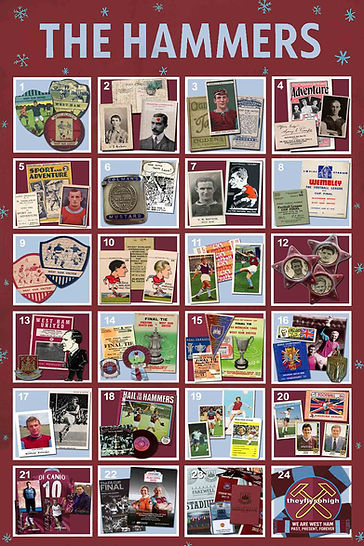
Steve was carried forward to August 2016, when West Ham United stepped into a new chapter at the London Stadium. The echoes of the Boleyn Ground still lingered - the creak of the old stairwells, the thunder of the Chicken Run, the final exhale of Winston Reid’s header - but now the claret‑and‑blue army gathered beneath sweeping modern stands, their voices rising to fill a new home.
The move was more than bricks and steel - it was a leap into the future. The London Stadium, once the stage of Olympic triumphs, now bore the banners of West Ham United. Supporters arrived with mixed emotions: pride in progress, sorrow for the Boleyn, and anticipation for what lay ahead. Some carried memories like heirlooms; others carried hope like a torch.

As Steve walked through the concourse, he saw families in fresh shirts, old supporters telling stories of Brooking and Bonds, children hearing the name Di Canio for the first time. The past was not fading - it was being woven into the fabric of the new.
Though the Boleyn Ground was gone, its spirit lived on in every chant, every banner, every bubble blown at the London Stadium. The move was not an ending, but a continuation - the story of West Ham United carried into a new age, rooted in East London pride yet reaching for wider horizons. The lanterns of memory drifted upward, settling into the rafters of the new ground, lighting the way forward.
From that day on, the advent calendar was placed in a glass case in the Club’s London Stadium boardroom, and every December, fans young and old came to see it. Some swore they felt the cold of Wembley, or heard the echo of Bobby Moore’s voice. Others simply smiled, knowing that behind each door was not just a trinket - but a piece of West Ham’s heart.
For the scarf in the final door was not a relic. It was a reminder. That West Ham United is not a ground. Not a postcode. Not a single moment in time. It is a journey - carried by its people, shaped by its memories, renewed by every generation that sings Bubbles into the night.
Past. Present. Forever.
Merry Christmas
Wishing you a Christmas filled with warmth,
wonder, and the stories that make us who we are.